Brynnpark Productions

Level 2 SR brought to you by

2026 Summit March by Jack Wilds Key: Eb throughout Instrumentation: Clarinet & Trumpet have 1st/2nd parts. Everyone else unison No accidentals. ERRATA - error in the level 2 tuba part. Towards the end, it jumps from a low Bb up a 9th to 2nd space C. The rest of the low brass just go up a step. It was reported to Gabe Musella. May be just in score. Not sure if on kid's part. Several places where high brass/ww have whole notes while LB/LWW have a half note and 2 quarter notes 4 bar woodwind section followed by a 2 bar brass/percussion section. rhythm in those sections is quarter, eighth eighth, quarter, rest. MORE INFO: Low brass and low woodwinds no rhythm harder than fourth-quarter notes. Mostly half notes or half note and two Quarter notes. No slurs It was written to the rubric. Percussion: Snare, Bass, Crash Cym, Triangle, Bells, Timpani


2025 Resolution Fanfare by Carol Brittin Chambers Key - Bb; Tempo - Maestoso Piece is quite short - around 36 measures. Very playable but if your kids struggle with breathing every 2 measures it will show immediately Two back to back sections that trumpets and snare drum drop out with limited percussion to help with timing. Limited crescendos and decrescendos. Accents in last five measure are only articulations. Winds have nothing harder than a quarter 2 8th and a half note or two quarters. Range is basically a Bb concert scale. A few measures with rest on Count 4 NEW: Before the last rehearsal number of the piece, the flutes have an a natural on beat four so make sure they don't miss it. It may be doubled as a b in the trumpets (I would assume) but not sure. The alto saxes have several f sharps. There are places where high voices have a melody and the low voices have quarter note, quarter rest stuff underneath. It's not challenging but the rhythm changes slightly from measure to measure. The melody for a few sections is four quarters notes with a slur under the first two notes The snare part has like a 1 2te 3teta 4 situation There's a rehearsal block at m. 9 but the trumpets come in 4 measures after 9. There are a few dotted half note rhythms. Crescendo into a rest on beat four followed by a forte entrance on 1 around halfway through the piece PRACTICE WILLIE OWEN'S PRIDE OF AMERICA as this is a lot like it Percussion: Snare Drum Bass Drum, Cymbals, Triangle, Timpani, Bells

2024 Walk of Courage by Carol Brittin Chambers Key - Eb; Time - 4/4; Tempo - Moderate march 1st four measures unison rhythms. Clarinets and trumpets have parts that go from 2 part to unison in several places at 5. 12 is basically a repeat of first phrase, but at f. At 20, low brass rhythm is half note, half note, quarter, eighth, eighth, quarter, quarter. Woodwinds is the opposite. @ 25 the trumpets come in with the quarter, eighth, eighth, quarter, quarter rhythm. Last four measures has unison rhythms. Upper winds and brass have a dotted half note with the low brass having quarter notes in a couple of spots. When winds have a dotted half note, snare usually has sixteenths on count four. The TC Baritone part does not match the BC baritone part on beat 1. If played as written, it should sound as if a wrong note was played. More information: VERY PLAYABLE. Very straight forward. key of Eb. Only slurs in the piece are where the half notes are, and that's only 3-4 measures. The biggest thing she has that looks like it needs to be emphasized are the dynamics and accents. They change every 6-8 measures. MORE INFORMATION: Very much playable. Block band stuff through most of it. Low Brass unison through most. Low Brass have some leaps from middle Space Eb to Higher Bb and back down. the MIDDLE SECTION is slightly different from the rest so be sure to hit it. Students may feel a bit insecure since its softer and a different melody. The hardest rhythm is the 1 2& 3 4. The end is a repetition of the beginning. AA BA type piece. A section is super easy and the B section is just as easy, but different. Can confirm all the other info that's been posted so far. Ending is unison rhythms. Short - about 36ish measures long (cant remember for sure but it was around 36 measures. Plenty time to play through it a few times if you choose to. Percussion is very playable. Small one note timpani solo at the end (quarter not pick up to like the last two bars, but only the timpani has it) The flow and tempo are very steady. Allegro Moderato. Range is very playable. Highest note in trumpet was a fourth line D. Low Brass go to top of staff Bb. The two eight notes that are part of the melody do change, but in the low brass the eighth notes are just repeated notes mostly.
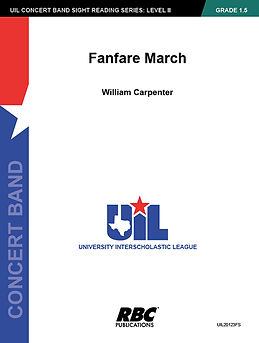
2023 Fanfare March by William Carpenter Key - Eb throughout; Time - 4/4 throughout ERROR in the Clarinet 1 part. It jumps up an octave higher in one measure. Our region just covered up that measure and rewrote it. Haven’t heard anything from Gabe Musella about that error. *NOTE: Error has been fixed on part, but not on score As written in their part, goes up to high Bb above the staff. Measure 38, Count 4, the oboe Eb should be up an 8va in unison with the flute Moderate march tempo. Low reeds and low brass have a Db accidental. Staccato quarter notes show up throughout. More info: Melody- 3 4 1 2& 3 4 1- 3 4 1—— Some have a whole rest in measure 1 and come in on measure 2. Horns start on Eb. Low Brass get melody that’s a repeat of first melody introduced. They need to play strong. Upper Woodwinds get a new melody that has some changing 8th note patterns. Be sure to balance accompaniment to them. Staccato quarter notes in accompaniment. Percussion have whole note and half note rolls, flams, etc. (need a strong snare drum reader/player). Timpani has some entrances on beat 3. Ends on a tied whole note to an 8th note on beat 1. Several dynamic changes, crescendos, decrescendos. Nothing surprising. Be careful of concert A-flats. Euph/Tuba have concert D-flats. Remember that accidentals carry through the measures! Very Playable. Just keep in mind the moderato march style. More info: The grade 2 Sight-reading is in eb. It has 2 occurrences of concert Dbs in the first 16 measures in the tenor and bass voices. Then the rest of the piece is all in key. March tempo. All the dynamic changes are measure long crescendos or decrecsendos in the last bar of a phrase. The last note is a whole note ff eb major chord. All the melody parts are doubled. Trumpet, flute, clarinet 1 have it at one point, alto sax and French horn at one spot, and all tenor and bass voices at another. The trombone and baritone parts are identical throughout. There is a juxtaposition of the background parts with staccato march style quarter notes against connected melody. Despite being labeled as march tempo, all the staccatos are marked. The melody is almost the same every time it is stated, each time with a new group. The dynamics were written as block dynamics, meaning that each time a new group gets the melody the background parts will need to back off to make melody prominent. Tympani are F, Bb and Eb Percussion: Timpani, Bells, Snare Drum, Bass Drum, Crash Cymbals, Triangle

2022 Big Creek Overture by Dennis Eveland Key - Bb, changing to Eb in middle. Time - 4/4 throughout. Andante start changing to march tempo/style Beginning has several crescendo/decrescendos. Key change/tempo/style change at meas 25. Detached style. Ritardando about 2 or 3 measure before with fermata and GP before key change. Need to watch out for concert A naturals in 1st 8 meas. Mostly flute, clarinet and trumpet melody throughout. Saxophone does have melody at times. Biggest issue seems to be the Ab/A-naturals in low brass. Very playable After key change is similar to Washington Post. Most complicated rhythm is dotted-quarter, 8th, half-note. Baritone and tuba are separate lines. All those A naturals in the beginning are in the baritone/trombone line. once the key change happens trumpets don’t play a Bb until the end of the piece. They have time to forget the key signature. Last note is whole note tied to 8th. Make sure kids are watching for your cutoff.

2021 Clear Creek Canyon by Carol Brittin Chambers NO INFORMATION AVAILABLE


2020 Ridgeview Overture by Carol Brittin Chambers NO INFORMATION AVAILABLE

2019 A Renaissance dance by Jack Wilds NO INFORMATION AVAILABLE


2018 Paramont Fanfare by Mark Lortz Key: Bb throughout; Time Signature: 4/4; Tempo: Allegro moderato Notes; Courtesy accidentals can be confusing to kids. Piece beings with half notes on all parts Measures 4-5 are percussion break Measures 3, 8 and 12 have fp on long tones Measures 16-20 Flute soli with percussion break. Must balance Concert Ab and Db accidentals Accents and staccatos all over the place Measures 47-50 Flute has moving eighth notes while band has long tones. Balance this Measure 55 - Quarter note followed by dotted half in all parts except flute Several long slurred phrases in piece All watch out for accidental trumpets Bb on occasionErrata: Timpani - F, Bb is indicated below the first measure, but should be - F, Bb, Eb (there are 3 pitches on the part). Please mark score and part. Percussion 3 - there are no labels on the actual part that indicate when the triangle vs. crash cymbal are played. The upper note on line 5 is the triangle, the lower note on space 4 is the crash cymbal. Should be called Accidental Fanfare. It’s written in Bb but there are so many concert Ab accidentals in Flute, tpt, cl, and trb, and bar lines that it leads me to believe it actually is in the key of Eb major tonally. Also, Alto saxes have b-flat accidentals, 2nd tpts, 2nd cl. see e-flat accidentals, and horns see Ab accidentals a few times. Piece starts out with big unison half notes for two measures in fanfare style, but no percussion. M.3 - drums add in and the half notes continue. There is a 2 measure drum break with exposed snare,bass, timpani (think Olympic fanfare) the band comes back in with big unison half notes and these contain the Db concert accidentals in horn, alto, 2nd tpt and 2nd cl, and that concludes the intro. The first main phrase begins with cl, tpt melody. Low brass has relatively easy accomp. There is a small rhythm trap for drummers in this phrase. They have an awkward beat 2 entrance for snare bass timp. They have to be good rest counters. 2nd chunk of the song- Totally exposed flute riff. Snare and flutes play alone for 4 measures followed by big low winds whole note entrance. And another 4 measures of accomp to the flute riff. 3rd chunk of the song- clarinets and middle voices have a lyrical section it’s between C and A on the clarinet so doesn’t go over break. 4th chunk- the same lyrical passage is repeated but there’s one big trick here. Tpts play the same exact lyrical passage but offset by one measure! So you have a round happening basically. This works best if you cue the Tpts. Don’t let them just try to enter on their own. 5th chunk - Fanfare returns but now in moving Quarters. Flutes have independent part! Flutes have 6 moving eights in a row so this maybe hardest technical passage for them. 6th chunk - this rhythm becomes the main rhythmic motif - 1 2 3 4&. With staccato articulation on the 4&. Last section- nothing to bad here except they throw in one tricky rhythm - quarter note followed by dotted half. “1 2——“ Overall fanfare at the start. Exposed flute. Lyrical mid section that becomes a round with the trumpets, then back to fanfare to finish. Concert Ab accidentals everywhere and they carry through the measure.

2017 ...To the Rescue by Brian Beck Key: Bb throughout; Time Signature: 3/4 changes to 4/4; Tempo: Andante Tranquillo changes to Allegro Notes: Very playable. Opens in concert Bb and stays the whole way. -Starts in 3/4 and changes to 4/4 about halfway. -3/4 section has a 4 bar introduction with dotted half notes. Half notes and quarter are common and frequent in the accompaniment (low brass) -Lots of quarter notes (1 2 3) in melody -1st Clarinet, 1st Tpt and Flute have melody -Opening is Andante Tranquillo. -Measure 5: 1st theme - very playable 3/4 melody (flutes and tpts have lots A naturals) -FH and alto sax have counter melody that 1&2 3. Very playable and not high. In D, E, F, G region on horn -Very long rest for FL and other high winds then a very awkward entrance at m 12 -Low Brass have some 1&2 3 rhythms -Lots of accidentals, mainly concert Ab, as get closer to fermata and caesura -There is a fermata and caesura with a release to end the 3/4 section. -In the middle is a time signature change to 4/4 and a tempo change to allegro. -The 4/4 begins with a 4 measure drum break. Very active snare, bass, and triangle. Snare plays: 1& 2e&a 3& 4e&a over and over again. That’s the main riff for the 2nd half of the song. -Full band minus low brass enters with 1 2&3 4&1 2&3 4&1 2&3 4 -8th notes marked with staccatos -Accidental on beat for all of the melody (concert Ab) in flute, 1st tpt, 1st clarinet - gives tune modal sound -After 8 measures low brass enters with same riff, but THERE'S A TRAP! There is a rest on beat one after 2 measures of the riff. -Measure 39 - very playable section. Low brass has half note 2 quarter pattern repeated ad nauseum, with occasional 2 8ths on beat 4. -High voices have 1 2&3 4 over and over again in a somewhat modal riff. Lots of concert Ab's -Ending - Unison whole note with a breath mark -Measure of 2 half notes then unison whole note -Last measure has a trap - REST ON ONE!! Then 2&3 Every so often is an accidental usually to concert Ab. Watch the last measure. Everyone is in unison on concert Bb and rhythm is quarter rest on beat 1, eighth note pair on beat 2 and quarter note on beat 3 with a quarter rest on beat 4. MORE INFORMATION: -Clar. 1 goes over the break and Trumpet 1 to 4th line D

2016 Echo Point Canyon by David Herring NO INFORMATION AVAILABLE


2015 Variations on a theme by Haydn by Michael Worthington Key: Eb all way through. A natural accidentals; Time Signature: 4/4 throughout; Tempo: Leggerio and marcato. Notes: One fermata at end of first section. Exposed cl and sax and triangle. Dotted quarter 8th 2 times in a row. Melody in trumpet at first with low brass on 1 and 3

2014 Block Party by William Owens Key: Eb...NO ACCIDENTALS! NO tempo changes or other funny business. Very straight forward. Per William Owens, there are NO dotted quarter-eights! Very playable!More info: Low Brass melody - "something tells me I'm into something good" and I think a variation of Skip to my Lou? There is a section where the LB takes the melody but it's not that bad. Many 1's for this piece